
Unilateral Laminotomy for Bilateral Decompression (ULBD)
A Less Disruptive Approach to Lumbar Spinal Stenosis
Lumbar spinal stenosis occurs when the space available for the nerves in the lower back becomes narrowed. This narrowing may develop from a combination of thickened ligamentum flavum, enlargement of the facet joints, and bony overgrowth associated with arthritis and degeneration of the spine.
When the narrowing becomes severe enough, it can compress the nerves and cause symptoms such as:
Pain, numbness, or tingling in the legs
Leg heaviness or weakness with walking
Difficulty standing or walking for prolonged periods
Relief when sitting or leaning forward
Buttock or leg pain
Reduced walking endurance
When nonsurgical treatments are no longer providing adequate relief, surgery may be considered to create more room for the nerves.
One technique I use for appropriately selected patients is called Unilateral Laminotomy for Bilateral Decompression, or ULBD.
What Is a ULBD?
The name sounds complicated, but the concept is relatively simple:
We approach the spinal canal from one side while decompressing the nerves on both sides.
Traditional decompression surgery may involve removing a larger portion of the posterior elements of the spine to access the spinal canal.
With ULBD, I create a smaller opening—or laminotomy—through one side of the lamina. Through this working corridor, I can remove the bone and thickened ligament causing stenosis on the side of the approach and then work underneath the spinous process to decompress the opposite side.
The goal is the same as a traditional decompression:
Give the nerves more room.
The difference is how we get there.
How Is a ULBD Performed?
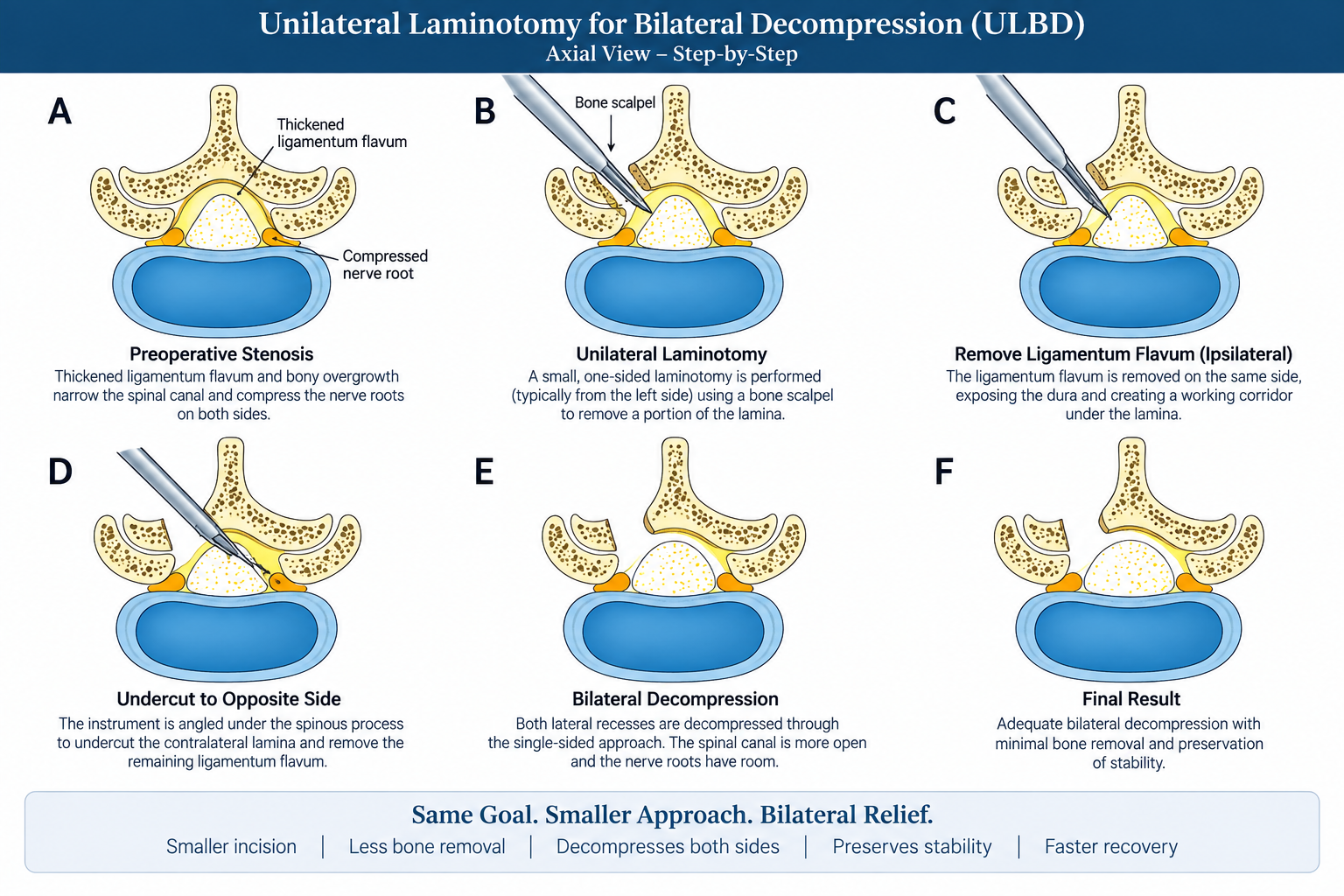
The illustration above shows the procedure step-by-step.
A. Spinal Stenosis Before Surgery
Before decompression, the spinal canal may be narrowed by thickened ligament, enlarged facet joints, and bone.
The nerves have less room, particularly within the lateral recesses where the individual nerve roots travel.
B. Creating the Unilateral Laminotomy
A small opening is created through the lamina on one side of the spine.
I may use a bone scalpel along with other microsurgical instruments to precisely remove the amount of bone necessary to create the working corridor.
Unlike a complete laminectomy, the goal is not to remove the entire lamina.
C. Decompressing the First Side
Once the opening has been created, the thickened ligamentum flavum and other structures compressing the nerves can be carefully removed.
This creates additional room for the nerve root on the side from which we approached.
D. Reaching the Opposite Side
This is what makes ULBD particularly useful.
Rather than creating another large opening on the opposite side, the surgical instruments are angled underneath the spinous process and contralateral lamina.
This allows me to remove the ligament and bone contributing to stenosis on the opposite side while continuing to work through the original unilateral approach.
E–F. Bilateral Decompression
After the decompression is complete, the central spinal canal and both lateral recesses have more room.
The goal is adequate decompression of the nerves while preserving as much normal bone, facet joint, ligament, and supporting anatomy as reasonably possible.
ULBD vs. Traditional Laminectomy
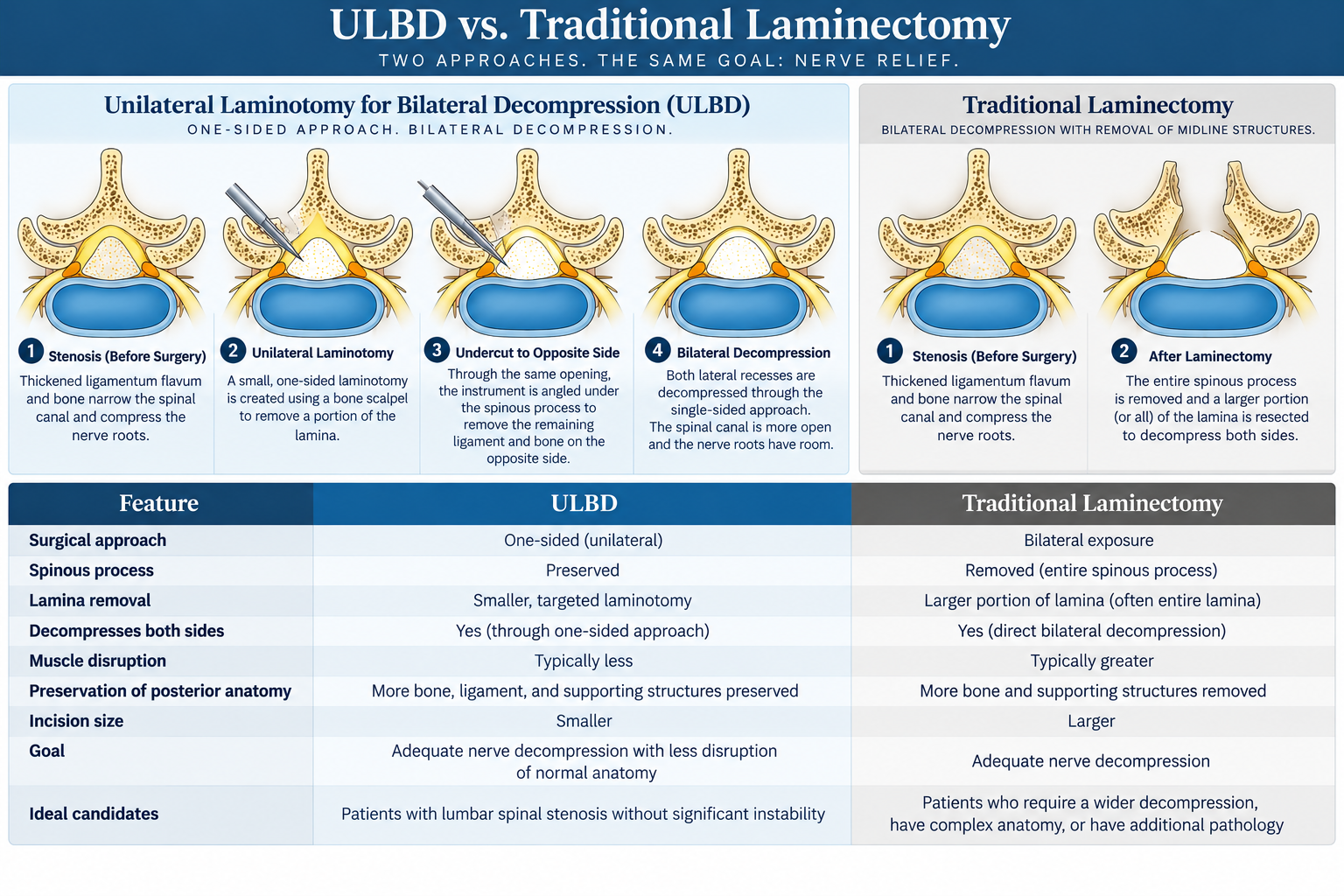
Both procedures can be effective operations for lumbar spinal stenosis. The primary difference is the surgical approach.
Can we accomplish the necessary decompression while disrupting less normal anatomy?
When the anatomy allows it, ULBD may provide that opportunity.
Why Preserve More of the Spine?
The lamina, spinous process, facet joints, muscles, and supporting ligaments all contribute to the posterior structure of the lumbar spine.
Removing enough bone to adequately decompress the nerves is essential—but removing additional normal anatomy does not necessarily improve the decompression.
With a ULBD, the objective is therefore:
Remove what is causing the compression while preserving what isn't.
Maintaining more of the normal posterior structures may reduce surgical disruption and may help preserve spinal stability.
Does ULBD Mean I Won't Need a Fusion?
Not necessarily.
ULBD is primarily a decompression procedure, not a fusion procedure.
Some patients have spinal stenosis without significant instability and may be candidates for decompression alone.
Other patients may have additional problems such as:
Significant spondylolisthesis
Spinal instability
Severe deformity or scoliosis
Significant foraminal collapse
Mechanical back pain associated with instability
Previous surgery that has altered the anatomy
In those situations, decompression alone may not adequately address the underlying problem, and a fusion may sometimes be recommended.
This is why I evaluate the MRI, X-rays, spinal alignment, symptoms, physical examination, and overall goals rather than recommending the same operation for every patient with stenosis.
What Is Recovery Like After ULBD?
Recovery varies depending on the number of levels treated, the severity of stenosis, the patient's overall health, and the physical demands of work and daily activities.
In general, I encourage patients to get up and begin walking early after surgery.
Walking is one of the most important parts of the early recovery process.
Patients commonly experience some postoperative soreness around the surgical area, but the operation is designed to minimize unnecessary disruption of the surrounding tissues.
For many patients undergoing a minimally invasive decompression, restrictions are considerably different from those following a lumbar fusion.
The objective is not prolonged inactivity. It is a gradual return to normal movement and activity as the surgical area heals.
Who May Be a Candidate for ULBD?
ULBD may be considered for patients with symptomatic lumbar spinal stenosis whose symptoms correlate with their imaging and who have not obtained adequate improvement with appropriate nonsurgical treatment.
The decision is individualized.
An MRI that shows stenosis does not automatically mean surgery is necessary, and not every patient requiring decompression is best treated with ULBD.
The most important question is not simply:
"Do you have spinal stenosis?"
It is:
"What is causing your symptoms, and what is the least disruptive procedure that can adequately address that problem?"
The Molina Spine Approach
My goal with lumbar decompression surgery is straightforward:
Adequate decompression with the least necessary disruption of normal anatomy.
For appropriately selected patients, unilateral laminotomy for bilateral decompression allows us to access both sides of the spinal canal through a smaller unilateral approach.
One-sided approach. Bilateral decompression. More normal anatomy preserved.
Considering Surgery for Lumbar Spinal Stenosis?
If you've been diagnosed with lumbar spinal stenosis and are having increasing difficulty walking, standing, or performing normal activities despite nonsurgical treatment, an evaluation can help determine which treatment options fit your particular anatomy and symptoms.
Schedule a consultation with Molina Spine in Springfield, Ohio to discuss your options for lumbar spinal stenosis, including minimally invasive decompression techniques.
This information is provided for general patient education and does not replace an individualized medical evaluation. Surgical recommendations, risks, benefits, alternatives, and expected recovery vary depending on each patient's diagnosis, anatomy, medical history, and goals.